
News
GNSS remote sensing - how to increase the quality of numerical weather models
15-11-2024
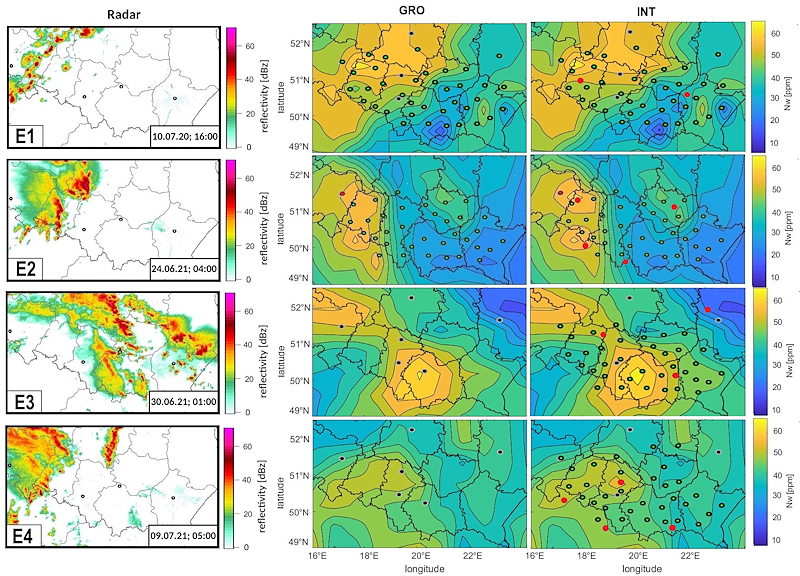 Understanding atmospheric conditions is one of the fundamental steps in creating accurate weather forecasts. However, the relatively limited number of ground-based measuring instruments significantly hampers this task, leading to a reliance on weather models that are not always precise. GNSS satellite techniques are increasingly being used as an alternative to classical meteorological instruments, due to the vulnerability of electromagnetic waves to varying atmospheric parameters, including water vapor. One of the most widely used to ols for monitoring the state of the atmosphere with GNSS observations is GNSS tomography.
 more...
International Summer School on UAV Photogrammetry, Laser Scanning and Bathymetry
24-09-2024
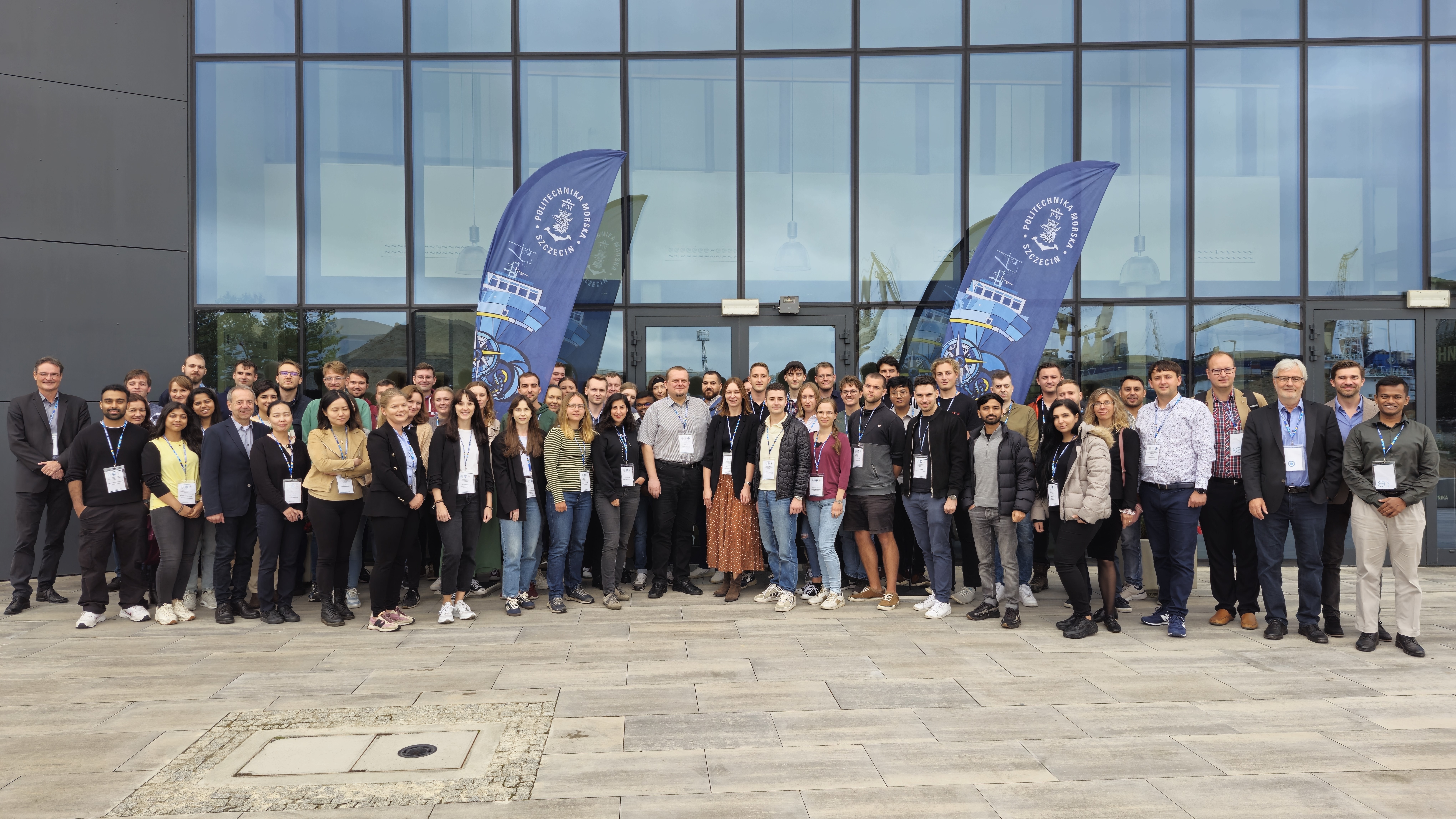 From 16th to 18th September 2024 was held the first edition of the International Summer School, organized jointly by the Polish Society for Photogrammetry and Remote Sensing (PTFiT) and German Society for Photogrammetry, Remote Sensing, and Geoinformation (DGPF). The event took place at the Department of Geodesy and Offshore Survey at the Maritime University of Szczecin. Dr hab. inż. Grzegorz Jóźków oraz dr inż. Małgorzata Jarząbek-Rychard from the Institute of Geodesy and Geoinformatics were involved in preparing lectures and tutorials. more...
IGiG scientific seminar - Prof. Kefei Zhang
18-09-2024
 IGiG is pleased to invite you to a scientific seminar, which will take place in a hybrid format, on Thursday (September 19th, 2024) at 9:00 AM. Prof. Kefei Zhang (School of Environment and Spatial Informatics, China University of Mining and Technology) will present the topic "Space Resources Exploitation and Utilization - A Geodetic Perspective".
The exploration and utilization of space resources is a new wave of international interest driven by the concern of rapid depletion of energy and resources on the earth. The US Space Resource Exploration and Utilization Act in 2015 was a tipping point for the accelerated process of new space competition. Pilot effort has been made by major space powers and sample-return missions have been launched/planned so far by Japan (Hayabusa), USA(OSIRIS-Rex), ESA (Rosetta) and China (Tianwen #2). The primary purposes of extra-terrestrial mining are to search for valuable and precious and rare minerals/metals, in particular those platinum group metals (e.g. ruthenium, rhodium, palladium, osmium and iridium) that are critically needed for the sustainable development of the society, from asteroids and minor planets that are close to the earth. geospatial science and technology, geodesy and remote sensing in particular, plays a critical role in this huge space mining systematic engineering endeavor, as is the case of surveying for large-scale engineering projects.
more...GNSS Summer School in Slovenia
09-08-2024

We are proud to share that several of our students recently participated in the Global Navigation Satellite Systems (GNSS) Summer School, which lasts for 10 days, organized by the European Space Agency (ESA) and the Joint Research Centre (JCR) in Slovenia.
more...AI-based Ensemble Troposphere Conditions Forecasting using GNSS tomography
26-06-2024
 Weather phenomena forecasting is undergoing a significant transformation with the latest research, introducing a AI-based to atmospheric prediction. The new study, published in IEEE Transactions on Geoscience and Remote Sensing, marks the pioneering use of GNSS tomography for ensemble forecasting, setting a new pathway in the field. Traditional troposphere models often struggle with low spatial resolution and irregular data distribution. By leveraging GNSS troposphere tomography, the study generates high-resolution, three-dimensional wet refractivity fields, effectively addressing these critical challenges. Unlike previous deterministic models, the research employs ensemble forecasting using Generative Adversarial Networks (GAN), enhancing predictive accuracy by generating realistic time series data and providing probability-based forecasts. At the core of the model are Long Short Time Memory (LSTM) networks, optimized with Genetic Algorithms (GA), ensuring robust predictive performance more...
Archive: « PREVIOUS PAGE | 1 | 2 | 3 | 4 | 5 | 6 | 7 | 8 | 9 | 10 | 11 | 12 | 13 | 14 | 15 | 16 | 17 | 18 | 19 | 20 | 21 | 22 | 23 | 24 | 25 | 26 | 27 | 28 | 29 | 30 | 31 | 32 | 33 | NEXT PAGE »
 |
 |
 |
 |
Contact
|
INSTITUTE OF GEODESY AND GEOINFORMATICS
Wroclaw University of Environmental and Life Sciences Grunwaldzka 53 50-357 Wroclaw NIP: 896-000-53-54, REGON: 00000 18 67 Phone +48 71 3205617 Fax +48 71 3205617 e-mail: igig@upwr.edu.pl |