
News
24th Polish Scientific Symposium Photogrammetry, Remote Sensing and Geoinformation in Digital Reality Modeling
29-09-2026
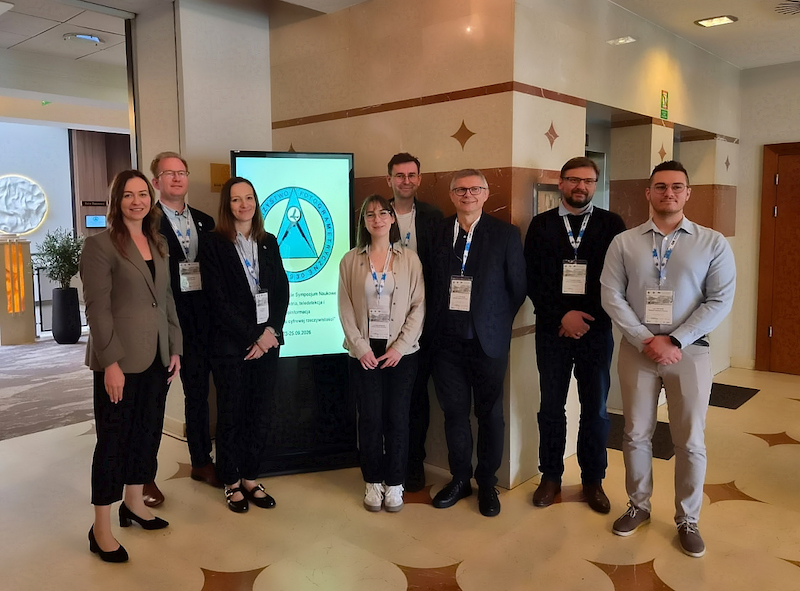 From 23 to 25 September 2026, researchers from Wrocław University of Environmental and Life Sciences took part in the 24th Polish Scientific Symposium “Photogrammetry, Remote Sensing and Geoinformation in Digital Reality Modeling” held in Kielce.
The event was organized by the Polish Society for Photogrammetry and Remote Sensing (PTFiT), the Main Board of the Association of Polish Surveyors (SGP) and the Department of Geodesy and Geomatics at Kielce University of Technology.
Over the three days of the symposium, researchers from the Institute of Geodesy and Geoinformatics presented work spanning a broad range of topics – from photogrammetry and laser scanning to machine learning, BIM and digital twins.
 more...
Application of a GNSS ARO Observation Operator for Data Assimilation During a Sequence of Atmospheric Rivers
23-09-2026
 A new scientific publication entitled “Assimilating GNSS Airborne Radio Occultation Bending Angles With MPAS–JEDI During a Sequence of Atmospheric Rivers” has been published as a result of international scientific collaboration, with Dr Paweł Hordyniec from the Institute of Geodesy and Geoinformatics at UPWr, Poland among its co-authors.
 The study presents the application of GNSS Airborne Radio Occultation (ARO) observations for atmospheric data assimilation.
more...Wrocław University of Environmental and Life Sciences and the Municipality of Wrocław Sign Cooperation Agreement in Urban Geoinformatics
10-08-2026
On 4 August 2026, the Wrocław University of Environmental and Life Sciences (UPWr) and
the Municipality of Wrocław signed a cooperation agreement to work together on research
and projects in the field of urban geoinformatics.
The agreement was signed by Professor Krzysztof Kubiak, Rector of UPWr, and Robert
Bednarski, Deputy Director for Smart City at the City Promotion and Tourism Department,
representing the Municipality of Wrocław.
the Municipality of Wrocław signed a cooperation agreement to work together on research
and projects in the field of urban geoinformatics.
The agreement was signed by Professor Krzysztof Kubiak, Rector of UPWr, and Robert
Bednarski, Deputy Director for Smart City at the City Promotion and Tourism Department,
representing the Municipality of Wrocław.
A Major Distinction for IGiG UPWr! Our Researchers on the Organising Committee of ISPRS Geospatial Week 2027 in Warsaw
22-07-2026
 In 2027, Warsaw will host ISPRS Geospatial Week 2027 - one of the leading scientific events held under the auspices of the International Society for Photogrammetry and Remote Sensing. We are pleased to share that representatives of the Institute of Geodesy and Geoinformatics at the Wrocław University of Environmental and Life Sciences have joined the Organising Committee of this event. more...
SWIM-GNSS – New IGG Project Selected for Funding in the NCBR Poland–Taiwan Joint Research Projects Call
18-06-2026
 Within the framework of the 13th Poland–Taiwan Joint Research Projects Call, the SWIM-GNSS (Severe Weather Understanding through Integrated Moisture Retrieval from GNSS) project entitled “Innovative moisture retrieval from integrated GNSS observations as a key to understanding severe weather events” has been selected for funding. The project is funded by the National Centre for Research and Development (NCBR) and Taiwan’s National Science and Technology Council (NSTC). The research will be carried out by scientists from the Institute of Geodesy and Geoinformatics in collaboration with National Central University and National Taipei University, Taiwan. The Principal Investigator on the Polish side is Dr Estera Trzcina.
The main objective of the project is to develop an innovative method for integrating GNSS observations to improve atmospheric moisture monitoring in the troposphere. The research will combine two complementary sources of atmospheric information: GNSS radio occultation observations and three-dimensional moisture reconstructions obtained using GNSS tropospheric tomography, using a model developed at the Institute of Geodesy and Geoinformatics. Particular attention will be given to reducing systematic errors present in radio occultation profiles within the lowest layers of the atmosphere.
more...Archive: | 1 | 2 | 3 | 4 | 5 | 6 | 7 | 8 | 9 | 10 | 11 | 12 | 13 | 14 | 15 | 16 | 17 | 18 | 19 | 20 | 21 | 22 | 23 | 24 | 25 | 26 | 27 | 28 | 29 | 30 | 31 | 32 | 33 | NEXT PAGE »
 |
 |
 |
 |
Contact
|
INSTITUTE OF GEODESY AND GEOINFORMATICS
Wroclaw University of Environmental and Life Sciences Grunwaldzka 53 50-357 Wroclaw NIP: 896-000-53-54, REGON: 00000 18 67 Phone +48 71 3205617 Fax +48 71 3205617 e-mail: igig@upwr.edu.pl |